Catalina’s grief and mourning after Arthur’s death
The Constant PrincessCatalina of Aragon’s grief after the death of Arthur, Prince of Wales, is both a private bereavement and a force shaping her life at the English court. She loses her husband at sixteen, but does not simply withdraw from the world: she works to contain her mourning while pursuing the future she believes Arthur entrusted to her. His absence persists in the silences, rituals, and political choices that follow.
Death and the first days of mourning
On 2 April 1502, at vespers, Arthur’s confessor, Dr. Eldenham, administered extreme unction, and Arthur died soon after. Catalina knelt at the threshold while the priest anointed him and gave the blessing. She remained there until she was told that her husband was dead. In that moment, she became a widow at sixteen.
Margaret Beaufort and Doña Elvira helped her to her bedchamber. There, the immediate facts of loss became inseparable from the ordinary intimacies of their marriage: Catalina understood that Arthur would no longer come to her door or draw her into his arms. Her broken response was brief, but the narrative gives the silence that follows much greater weight. The loss is not only of a prince or a political future; it is the end of the daily closeness through which she had known him.
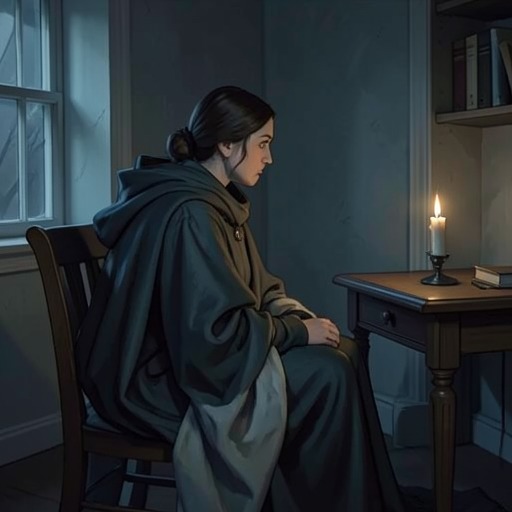
During the first month, Margaret Beaufort and Doña Elvira told others that Catalina was ill but not in danger. They feared for her mental state. She did not rage or weep openly. Instead, she lay facing the wall, and the effort of holding back her grief consumed her strength. The restraint is presented as deliberate and precarious: Catalina believes that if she gives way to weeping, she may not be able to stop. Her silence is therefore not evidence that she feels little, but the means by which she tries to endure what she cannot yet express.
Seclusion and the work of remembrance
When she was woken, Catalina said that she was tired. She allowed her attendants to dress her, sat rigidly in a chair, and returned to bed when she could. The colored tester above her bed, once associated with her life beside Arthur, became a fixed reminder of what could not be recovered. Her grief is rendered through repeated, ordinary actions rather than public lament: staying in bed, sitting still, and facing the place where she had shared her days with him.
The physician, Dr. Bereworth, could not enter that private grief as a comforter. When she saw him, Catalina turned away and shut herself in her bedchamber. She associated him with the failure to save Arthur and felt anger toward him, wishing, in her distress, that the doctor had died instead. Margaret Beaufort told him that Catalina was not speaking or even weeping. The episode shows how grief distorts the relationships around the death: those who witnessed it or tried to treat her became difficult for Catalina to face, even as her attendants worried about her.
As spring came, Doña Elvira dressed Catalina in mourning clothes and persuaded her to sit by a window. The season’s return sharpened the contrast between the living world and her loss. The warmth and green landscape recalled plans she and Arthur had shared: walking by the river, welcoming the swifts, and planting salad vegetables in the castle gardens. These were modest hopes as well as royal ones. The land they had imagined inhabiting together remained, but Arthur was dead, and the future they had pictured could no longer be lived as a couple.
Grief carried into duty
On the journey to London, Catalina traveled behind the closed, black-trimmed curtains of her litter. She did not respond to the people who greeted her as the procession passed through villages, nor speak to her companions, including María de Salinas. Observers interpreted her silence as a grief so profound that she might not recover. They imagined she could return to Spain and marry again. The narrative reveals a different explanation: Catalina is holding her mourning back until she considers it safe to feel it.
During the journey, she is thinking not about how to replace Arthur but about how to fulfill his dream and obey the promise he had asked of her. She resolves to keep the account of their marriage that he had instructed her to maintain, despite recognizing the danger of facing Henry VII and Margaret Beaufort. Her determination joins personal fidelity to a political purpose: she intends to help secure the kind of rule Arthur wanted for England. The grief is thus delayed, not ended. She continues to carry it while turning her attention toward the task she understands as her last service to him.
Her conduct years later makes clear that the promise remains active. When the question of marrying the widow of a deceased brother raises an objection on grounds of affinity, Catalina’s position depends on obtaining a papal dispensation and on the claim that her marriage to Arthur was not consummated. Dr. de Puebla confirms that this was the account he had been given. In later court proceedings, Catalina enters when the usher calls her name, although those present expect no answer. She stakes her case on Henry VIII’s reluctance to contradict her account and publicly challenge her bond with Arthur. Her defense is a legal and dynastic act, but it is also shaped by the history she has chosen to protect.
Anniversaries and later bereavements
On 2 April 1503, one year after Arthur’s death, Catalina spent the day alone in the chapel at Durham House. Father Geraldini said a memorial Mass at dawn. She stayed in the chapel without breaking her fast, praying before the altar and walking among its devotional pictures and carved furnishings. The anniversary did not make the loss more distant. Her grief felt as raw as it had when she first learned that Arthur would die.
That day also brings a particular fear: Catalina worries that she is forgetting his face. Sometimes she cannot summon a clear image of him, or can recall only an inadequate likeness. She responds by drawing her knees close and holding herself tightly, trying to withstand the anguish of that failure of memory. Mourning now includes not only longing for Arthur but anxiety that time may erode the details through which she remembers him. The annual return of the date gives this private fear a ritual setting, but no resolution.
Later losses make the memory of Arthur’s death newly present. During a pregnancy in January 1510, Catalina wakes in pain and realizes that the child cannot be saved. Her baby is stillborn, and she is unable to face Henry VIII or tell the court and her father herself. Her grief is intensified by remembering that Arthur had imagined a daughter who would be named Mary; she feels that she has failed him as well as her present family and kingdom. In February 1511, after another child’s death, she tells Margaret Beaufort that losing Arthur had felt like torture, while losing her baby feels like death itself. Margaret answers that Catalina will learn to bear the loss. The scene does not erase the earlier bereavement: it places it beside a new one, showing how the capacity to endure has become part of Catalina’s life.
Mourning and royal identity
When Catalina is crowned Queen Katherine of England on 24 June 1509, the ceremony gives public form to the destiny she has long pursued. She receives the holy oil, the scepter, and the ivory wand, and understands her queenship as a calling under God’s protection. The coronation is an achievement, but it is not a simple escape from mourning. Her account of the ceremony still connects her longing for queenship with the memory of Arthur, whose hopes for her remain part of how she understands her role.
The same combination of personal feeling and public responsibility appears when Henry VIII appoints her regent and governor of the realm before sailing for France. Catalina receives the Great Seal of State and authority over home defense. She welcomes the power and intends to use it against the Scots. Her confidence as a ruler has grown, yet the political life she claims is still narrated in relation to the promise made after Arthur’s death: she believes she is carrying forward his vision as well as her own.
Across these episodes, Catalina’s mourning changes its outward form—from seclusion and silence, to guarded movement through public space, to memorial observance, and finally to a continuing presence within political and legal decisions. The novel does not present grief as a stage she simply completes. Arthur’s absence remains legible in the future she works to shape, in the account of their marriage she risks defending, and in the later bereavements she measures against his death.